
Week 1
DAY 1 · Exodus 40: The Presence
Today's work is not to analyze. It is to see. Read slowly. Let the imagery land before you reach for meaning.
READ
- Exodus 40
WHAT'S HAPPENING HERE
Exodus has been a long story. Slavery, plagues, a sea split open, manna in the wilderness, a mountain on fire, a covenant cut, a golden calf, a covenant renewed, and finally: instructions for building a tent. Chapters 25 through 40 of Exodus are almost entirely about how to build the tabernacle, the place where God will dwell with His people. Chapter 40 is the moment it actually gets built. Moses does everything exactly as the LORD commanded: that phrase repeats seven times in Exodus 40 alone.
Then verse 34 happens.
"Then the cloud covered the tent of meeting, and the glory of the LORD filled the tabernacle.
Moses was not able to enter the tent of meeting because the cloud was settled on it
and the glory of the LORD filled the tabernacle."
Exodus 40:34-35 (NET)
SIT WITH THE IMAGERY
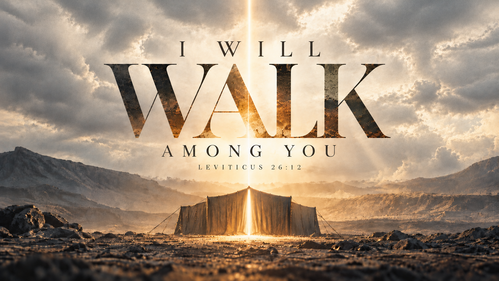
Before you answer anything, just look at what is there. A man named Moses has done everything God told him to do. The tent is finished. And then: God shows up. Not in a vision. Not in a word. As cloud. As fire. Settling onto the tent like a presence that has weight and substance. Then look at verses 36-38:
"But when the cloud was lifted up from the tabernacle, the Israelites would set out on all their journeys;but if the cloud was not lifted up, then they would not journey further until the day it was lifted up.
For the cloud of the LORD was on the tabernacle by day, but fire would be on it at night,
in plain view of all the house of Israel, throughout all their journeys."
Exodus 40:36-38 (NET)
Picture it. A camp of hundreds of thousands of people in a desert. By day, a cloud rests on the tent at the center of the camp. By night, fire. The whole nation moves when the cloud moves. They stop when it stops. Every person can look at the center of the camp and see, in plain view, that God is with them.
| WORD STUDY מִשְׁכָן (mishkan): dwelling place, tabernacle |
|---|
| Where you'll see this: Exodus 40:34, 40:35, 40:38: and throughout Leviticus |
| From the verb shakan, "to dwell." The mishkan is not a temple in the pagan sense: a house where you keep a god so you can use him. It is the dwelling-place of a God who has chosen to come down and live in the middle of His people. This same root gives us the rabbinic word Shekinah (the dwelling presence of God), and it shows up in the New Testament when John writes that the Word became flesh and "tabernacled" among us (John 1:14). |
WHAT THIS MEANS
Moses could not enter the tent he built. That is not a footnote. That is the thesis statement of the entire book of Leviticus.
Think about what it means that Moses: the man who spoke face to face with God on the mountain, the man whose face glowed so bright the people made him wear a veil, the man who had spent forty days in God's presence receiving the law: could not step into the tent he himself had built. This was not a failure of obedience. Moses had done everything exactly as the LORD commanded. Seven times the text says so. He built it right. He set it up right. He consecrated everything in exactly the order God specified. And then the glory fell. And he could not enter.
That is the condition of every human being before God. Not moral failure alone, not bad behavior: the sheer weight of divine holiness is itself a problem for fallen humanity. You can do everything right and still find yourself standing outside. The tent is real. The presence is real. The glory is real. And the distance is real. That distance is not God being cruel or distant by temperament. It is the consequence of Genesis 3, still in effect: the cherubim still guarding the way back, the gap between what God is and what we are not closed by good effort or careful obedience.
The cloud that kept Moses out in Exodus 40 is the same holiness that made Sinai untouchable (Exodus 19:12), the same fire that consumed Nadab and Abihu in Leviticus 10, the same glory that flattened Isaiah when he saw it in the temple (Isaiah 6:5). God's presence is not a gentle warmth that anyone can walk into. It is a consuming fire: and the entire book of Leviticus is God's answer to the question that Exodus 40 ends with: given that, how does anyone get in?
**→ *What does this image create in your mind? What word would you put on what you are seeing?***
**→ *Read Exodus 40:34-35 one more time. Moses cannot enter. What does that do to you?***
**→ *If the end of Exodus is a man who built exactly what God asked, and then could not enter what he built: what question is the next book going to have to answer?***
DAY 2 · Leviticus 1: The First Answer
Yesterday, Moses could not enter. Today, listen for what changes.
READ
- Leviticus 1 (slowly: about seven minutes)
START WITH THE FIRST VERSE
"Then the LORD called to Moses and spoke to him from the Meeting Tent."
Leviticus 1:1 (NET)
Read it again. Yesterday, the tent was sealed by glory. Moses could not get in. Today, the very first sentence of Leviticus opens with the LORD calling Moses: speaking out to him from the tent he could not enter.
**→ *What does that one shift: from Moses unable to enter, to the LORD calling out to him: tell you about God's heart?***
NOW READ THE WHOLE CHAPTER
Leviticus 1 is the instructions for the burnt offering. Don't try to memorize the details. Just notice the language. Watch for two phrases especially:
- "before the LORD": how often does it appear?
- "a soothing aroma to the LORD": what does that phrase suggest about the purpose of the offering?
Notice something else. The person bringing the offering is not a priest: it is an ordinary Israelite. Leviticus 1:4-5 has him lay his own hand on the animal's head and do the slaughtering himself. The substitution is personal. He is not watching someone else's animal die for him at a distance: he is putting his hand on the life that stands in his place.
[Hold onto that image of the hand on the head. You will see it again in Week 5, when the high priest lays his hands on the scapegoat: and again at the cross.]
**→ *This ordinary Israelite chose to bring his own animal and lay his hand on it. What is the chapter assuming he actually wants? Is the burnt offering about avoiding punishment, or about something else?***
| WORD STUDY קָרְבָן (qorban): offering, that which is brought near |
|---|
| Where you'll see this: Leviticus 1:2, 1:3, 1:10, 1:14 |
| The Hebrew word translated "offering" in Leviticus does not primarily mean "slaughter" or "payment." It comes from the root qarav, meaning "to draw near." A qorban is something brought near, given so that the worshiper may come near. Most of us were trained to hear "blood" and "sacrifice" and think only one thing: payment. But qorban says the payment was always in service of something larger: nearness. The blood does not just clear a debt. It opens a door that has been shut since Eden. When God says later in Leviticus, "I will walk among you" (26:12), this is how. |
THE WEIGHT OF THE HAND
The gesture in Leviticus 1:4 is precise and deliberate. The worshiper lays his hand: one hand, pressed down firmly: on the head of the animal. This is not a casual touch. The Hebrew verb samakh means to lean upon, to press with full weight. It is the same word used when someone leans on a staff hard enough to trust it with their body. The worshiper is transferring something. His hand is the point of contact between his life and the life that is about to be taken in his place.
What is being transferred is not vague spiritual guilt. It is the specific weight of a specific man's specific failure: pressed down by his own hand onto an animal that has done nothing to deserve what is about to happen to it. And then he picks up the knife himself. The priest handles the blood at the altar, but the slaughter in Leviticus 1:5 is the worshiper's act. He holds it. He does it. He watches the life leave. The substitution is not something he observes from a distance. It is something he participates in, at close range, with his own hands.
God designed it to be uncomfortable. That discomfort was curriculum. A man who had done this year after year understood in his body: not just in his theology: that sin costs a life. Not a fine. Not a ceremony. A life. And every time he walked back out of the tabernacle courts, he walked out because something else had died in his place.
[The hand on the head is not only in Leviticus 1. It reappears in Week 5 when the high priest lays both hands on the scapegoat and confesses the sins of the whole nation over it. And it echoes at the cross, where the weight of every human hand: every act, every failure, every life that owed what it could not pay: was transferred to the one who stood in our place voluntarily.]
**→ *When you think of the blood of Jesus, do you think 'payment,' or do you think 'nearness'? What changes if it is both: if the payment was always for the sake of the nearness?***
DAY 3 · Hebrews 8-10: Where This Is All Going
Today you get to peek at the destination. The point is not to understand all of Hebrews. The point is to see, faintly, what Leviticus has been pointing toward the whole time.
READ
- Hebrews 8: the better covenant
- Hebrews 9: the better tabernacle and the better blood
- Hebrews 10:1-25: the better sacrifice
AS YOU READ, NOTICE
The writer of Hebrews assumes you know Leviticus. He talks about the tabernacle, the priests, the blood, the Day of Atonement, the curtain: and he keeps using one word: better. A better covenant. A better priest. A better tabernacle. A better sacrifice. He is not dismissing Leviticus. He is saying Leviticus was always pointing somewhere.
"But now Christ has come as the high priest of the good things to come.
He passed through the greater and more perfect tent not made with hands,
that is, not of this creation, and he entered once for all into the most holy place
not by the blood of goats and calves but by his own blood,
and so he himself secured eternal redemption."
Hebrews 9:11-12 (NET)
**→ *Yesterday you read about an Israelite bringing a bull "before the LORD" so he could draw near. Today you are reading about Jesus entering the most holy place not by an animal's blood, but by His own. What does that do to you?***
**→ *What does it do to you to realize that Leviticus 1 and Hebrews 9 are telling the same story, separated by 1,500 years?***
You are not expected to understand all of Hebrews this week. You will come back to it. What matters today is that you start to feel the shape: Leviticus is not a strange book of old rules. It is a careful, intricate description of a problem: the problem of how unholy people can live near a holy God: and Jesus is the answer the book has been waiting for.
WHAT "BETTER" ACTUALLY MEANS
The writer of Hebrews uses the word "better" thirteen times across his letter. It is not a casual word choice. He is making a legal argument: the kind of argument a first-century Jewish reader trained in the Law would recognize immediately. He is saying: here is the old covenant institution, and here is what Christ provides in its place, and the comparison is not close.
A better covenant (Hebrews 8:6): because the old one was conditioned on Israel's faithfulness, and Israel could not hold it. The new covenant, cut in Christ's blood, is conditioned on His faithfulness. It does not break when you do.
A better tabernacle (Hebrews 9:11): because the old one was made with human hands, pitched in a desert, and subject to wear and weather. Christ passed through the greater and more perfect tent: not of this creation. The place where He now intercedes is not a tent that can be dismantled. It is the very presence of God.
A better sacrifice (Hebrews 9:23-26): because the old sacrifices had to be repeated. Every morning. Every evening. Every year on the Day of Atonement. The repetition was built-in testimony: this did not finish it last time. Every altar in Israel was a weekly confession that the work was not done. Christ offered Himself once. He did not come back out and repeat it. The once-for-all-ness of the cross is not a doctrinal technicality. It is the declaration that what every previous sacrifice could only promise, He actually accomplished.
You are not expected to carry all of this this week. Hebrews is a letter you will return to at every major turn in this study. What matters today is that you feel the shape of the argument: Leviticus is not the destination. It is the shadow. And a shadow is not a mistake: it is proof that something solid is casting it.
DAY 4 · Connecting the Dots
Today is the day you stop reading and start thinking. Pull the threads together. Don't rush these questions. Sit with each one before you write.
LOOK BACK
Over the last three days you have read:
- Exodus 40: God's presence falls on the tent, and Moses cannot enter.
- Leviticus 1: the LORD calls out to Moses, and gives the first offering by which a person can draw near.
- Hebrews 8-10: Christ enters the true holy place once for all, by His own blood.
Now go back further. Before Exodus, before the tabernacle, before the cloud: there was a garden.
"Then the man and his wife heard the sound of the LORD God moving about in the orchard at the breezy time of the day, and they hid from the LORD God among the trees of the orchard…
So the LORD God expelled him from the orchard of Eden to cultivate the ground from which he had been taken.
When he drove the man out, he placed on the eastern side of the orchard in Eden angelic sentries who used the flame of a whirling sword to guard the way to the tree of life."
Genesis 3:8, 23-24 (NET)
Eden was a place where God walked with humanity. Then humanity broke fellowship, and the way back was guarded by cherubim with a flaming sword. The next time we see cherubim in the Bible is on the curtain of the tabernacle: embroidered into the fabric that separates the people from the holy place (Exodus 26:31).
| WORD STUDY קָדוֹשׁ (qadosh): holy, set apart |
|---|
| Where you'll see this: Leviticus 11:44-45; 19:2; 20:7: more than 150 times in Leviticus alone |
| The defining word of Leviticus. Qadosh does not primarily mean morally pure (though it includes that). It means set apart, dedicated, belonging to a different category. God is qadosh in His very being: not because He follows the rules of holiness, but because holiness is what He is. The reason there has to be a tent, a curtain, a priest, and a sacrifice is not that God is far away. It is that God is qadosh, and unholy people cannot stand in the presence of holiness without being undone. The whole book is God's mercy: He is making a way for unholy people to come near. |
WHAT "BETTER" ACTUALLY MEANS
The writer of Hebrews uses the word "better" thirteen times across his letter. It is not a casual word choice. He is making a legal argument: the kind of argument a first-century Jewish reader trained in the Law would recognize immediately. He is saying: here is the old covenant institution, and here is what Christ provides in its place, and the comparison is not close.
A better covenant (Hebrews 8:6): because the old one was conditioned on Israel's faithfulness, and Israel could not hold it. The new covenant, cut in Christ's blood, is conditioned on His faithfulness. It does not break when you do.
A better tabernacle (Hebrews 9:11): because the old one was made with human hands, pitched in a desert, and subject to wear and weather. Christ passed through the greater and more perfect tent: not of this creation. The place where He now intercedes is not a tent that can be dismantled. It is the very presence of God.
A better sacrifice (Hebrews 9:23-26): because the old sacrifices had to be repeated. Every morning. Every evening. Every year on the Day of Atonement. The repetition was built-in testimony: this did not finish it last time. Every altar in Israel was a weekly confession that the work was not done. Christ offered Himself once. He did not come back out and repeat it. The once-for-all-ness of the cross is not a doctrinal technicality. It is the declaration that what every previous sacrifice could only promise, He actually accomplished.
You are not expected to carry all of this this week. Hebrews is a letter you will return to at every major turn in this study. What matters today is that you feel the shape of the argument: Leviticus is not the destination. It is the shadow. And a shadow is not a mistake: it is proof that something solid is casting it.
FOCUS QUESTIONS
**1. **In your own words: what problem is Leviticus solving? Don't just answer based on what you've read this week: answer based on the bigger story you are starting to see.
2. **Exodus 40 ends with God's presence with the people, but separated from the people. Leviticus 1 opens with God calling out to make a way. What does that one shift reveal about God's heart toward humanity? ◆ DISCUSS**
3. **If Genesis 3 is humanity being driven out of God's presence, and Hebrews 9 is Christ entering God's presence once for all on our behalf: where does Leviticus sit in that story? ◆ DISCUSS**
One more thread to pull before you move to Day 5. You have now held three texts in the same hand: Exodus 40, where God's presence fills the tent and Moses cannot enter. Leviticus 1, where God calls out from the tent and gives the first pathway in. And Hebrews 8-10, where Christ enters the true Most Holy Place on our behalf, once, permanently. These are not three separate ideas. They are one story in three movements. The first movement ends with a man standing outside, unable to approach. The second movement opens with God providing the first means of approach. The third movement shows where that approach was always heading: a High Priest who enters not with animal blood but with His own, who does not have to come back out and try again.
This is the arc you will follow for eight weeks. And the question Exodus 40 ends with: how does anyone get in?: is not an ancient Israelite question. It is the question underneath every man who has ever felt that God was present somewhere he could not reach, or present for people who were more qualified, or present in ways that required more than he could bring. Leviticus is God's sustained, careful, costly answer to that question. You are now inside it.
DAY 5 · Land It
Today is not for new information. It is for putting words on what you have seen: and for one last thing to wonder at before next week.
SOMETHING TO WONDER AT
God was extraordinarily specific about how the tabernacle was built and how Israel camped around it. In Numbers 2, He arranges the twelve tribes in four groups: three tribes to the east, three to the south, three to the west, three to the north: with the tabernacle in the dead center. When you count the number of people in each group and map out the camp, the arrangement is not a square. The eastern and western groups are larger; the northern and southern are smaller. Drawn to scale, the shape of the camp of Israel: with the tent of God's presence at its heart: forms a cross.
[A word of honesty: the text never says "this is a cross." The Israelites could not have seen it: and that is exactly the point worth pondering.]
God does nothing by accident. He was deliberate about every measurement, every position, every tribe's place. The people who lived it could not have known what the shape would one day mean. But God knew. Fifteen hundred years before a Roman cross stood on a hill outside Jerusalem, the presence of God already sat at the center of a people arranged in its shape.
**→ *Sit with that. What does it stir in you to realize God was pointing to the cross before anyone could have known?***
PUT IT INTO WORDS
**4. **In one sentence: what is Leviticus?
**5. **One word for what you saw this week:
**6. **What is one thing about God's heart that landed on you differently than before?
IF YOU WANT TO GO DEEPER (OPTIONAL)
For the man who wants to push further: write a short paragraph explaining Leviticus to a friend who has never read it and assumes it is just a list of old rules. What would you tell him it really is?
CARRY THIS INTO THE WEEK AHEAD
**→ *If God's heart from Eden to Revelation has been to dwell with His people, where is your heart right now toward His presence?***
DAY 6 · For the Group
Bring what you worked on this week. You will not get through every question below: they are a well to draw from, not a checklist. Pick the ones that fit the room, and let the conversation breathe.
BEFORE YOU GATHER
Before you walk into the room, carry this.
One week ago these men may never have read Leviticus seriously. They came in with assumptions: that it was about ancient rules, that it had nothing to say to a man trying to live today. What they sat with this week was different: the end of Exodus, where a man named Moses built exactly what God asked and then could not enter what he built. And then the first sentence of Leviticus, where God calls out to him. And then Hebrews, where a better priest enters once for all.
The men in your room may not have language yet for what has shifted. That is fine. The question underneath all three days is the same question underneath the whole book: how does anyone get near a God this holy? And this week you have been building the frame for an answer that will take eight weeks to fully arrive. This conversation is the first brick. Give it room. Let the men be honest about where they actually are with God's presence: hungry for it, distant from it, unsure they want it as much as they think they should.
OBSERVE: START WITH WHAT YOU SAW
**7. **What did you see in Exodus 40 that you had never noticed before?
**8. **When you pictured the camp: the cloud by day, the fire by night, the whole nation moving only when the presence moved: what stood out to you?
**9. **In one or two sentences: what problem is Leviticus solving?
DIG: GO AFTER THE THEOLOGY
**10. **Exodus 40 ends with Moses unable to enter. Leviticus 1 opens with God calling out to him. What does that one shift reveal about God's heart toward people?
**11. **We learned that qorban: 'offering': comes from a root meaning 'to draw near.' How does that change the way you've always understood sacrifice?
12. **Most of us were taught that the blood of Jesus is about payment for sin. Is it only that? What did this week add to that picture? ◆ DISCUSS**
**13. **The ordinary Israelite laid his own hand on the animal and held the knife himself. Why does it matter that the worshiper participated, instead of just watching a priest do it?
14. **Genesis 3 ends with humanity driven from God's presence, guarded by cherubim. Those same cherubim are embroidered on the tabernacle curtain. What is God communicating by that? ◆ DISCUSS**
EXAMINE: TURN IT INWARD
**15. **Be honest: before this week, how did you actually think about Leviticus? Has anything shifted?
**16. **Where have you treated access to God as casual: something assumed rather than received as a gift?
**17. **If God's heart from Eden forward has been to dwell with His people, where is your heart right now toward His presence: hungry, distant, distracted, indifferent?
**18. **Is there a part of you that relates to God mostly as a debt being managed, rather than a nearness being enjoyed? What would change if that flipped?
APPLY: CARRY IT OUT THE DOOR
**19. **What is one thing from this week you want to carry into the next seven days?
**20. **If drawing near to God is the whole point, what is one concrete way you could draw near this week: not out of obligation, but because the door is open?
CLOSE IN PRAYER
Before you pray, let one or two men share where they need God's nearness right now. Then pray for one another: not that God would be reachable, but that each man would walk through the door that is already open.
Coming Soon Week 2
DAY 1 · Exodus 40: The Presence
Today's work is not to analyze. It is to see. Read slowly. Let the imagery land before you reach for meaning.
READ**
- Exodus 40
WHAT'S HAPPENING HERE**
Exodus has been a long story. Slavery, plagues, a sea split open, manna in the wilderness, a mountain on fire, a covenant cut, a golden calf, a covenant renewed, and finally: instructions for building a tent. Chapters 25 through 40 of Exodus are almost entirely about how to build the tabernacle, the place where God will dwell with His people. Chapter 40 is the moment it actually gets built. Moses does everything exactly as the LORD commanded: that phrase repeats seven times in Exodus 40 alone.
Then verse 34 happens.
"Then the cloud covered the tent of meeting, and the glory of the LORD filled the tabernacle.
Moses was not able to enter the tent of meeting because the cloud was settled on it
and the glory of the LORD filled the tabernacle."
Exodus 40:34-35 (NET)
SIT WITH THE IMAGERY**
Before you answer anything, just look at what is there. A man named Moses has done everything God told him to do. The tent is finished. And then: God shows up. Not in a vision. Not in a word. As cloud. As fire. Settling onto the tent like a presence that has weight and substance. Then look at verses 36-38:
"But when the cloud was lifted up from the tabernacle, the Israelites would set out on all their journeys;but if the cloud was not lifted up, then they would not journey further until the day it was lifted up.
For the cloud of the LORD was on the tabernacle by day, but fire would be on it at night,
in plain view of all the house of Israel, throughout all their journeys."
Exodus 40:36-38 (NET)
Picture it. A camp of hundreds of thousands of people in a desert. By day, a cloud rests on the tent at the center of the camp. By night, fire. The whole nation moves when the cloud moves. They stop when it stops. Every person can look at the center of the camp and see, in plain view, that God is with them.
Where you'll see this: Exodus 40:34, 40:35, 40:38: and throughout Leviticus
From the verb shakan, "to dwell." The mishkan is not a temple in the pagan sense: a house where you keep a god so you can use him. It is the dwelling-place of a God who has chosen to come down and live in the middle of His people. This same root gives us the rabbinic word Shekinah (the dwelling presence of God), and it shows up in the New Testament when John writes that the Word became flesh and "tabernacled" among us (John 1:14).
WHAT THIS MEANS**
Moses could not enter the tent he built. That is not a footnote. That is the thesis statement of the entire book of Leviticus.
Think about what it means that Moses: the man who spoke face to face with God on the mountain, the man whose face glowed so bright the people made him wear a veil, the man who had spent forty days in God's presence receiving the law: could not step into the tent he himself had built. This was not a failure of obedience. Moses had done everything exactly as the LORD commanded. Seven times the text says so. He built it right. He set it up right. He consecrated everything in exactly the order God specified. And then the glory fell. And he could not enter.
That is the condition of every human being before God. Not moral failure alone, not bad behavior: the sheer weight of divine holiness is itself a problem for fallen humanity. You can do everything right and still find yourself standing outside. The tent is real. The presence is real. The glory is real. And the distance is real. That distance is not God being cruel or distant by temperament. It is the consequence of Genesis 3, still in effect: the cherubim still guarding the way back, the gap between what God is and what we are not closed by good effort or careful obedience.
The cloud that kept Moses out in Exodus 40 is the same holiness that made Sinai untouchable (Exodus 19:12), the same fire that consumed Nadab and Abihu in Leviticus 10, the same glory that flattened Isaiah when he saw it in the temple (Isaiah 6:5). God's presence is not a gentle warmth that anyone can walk into. It is a consuming fire: and the entire book of Leviticus is God's answer to the question that Exodus 40 ends with: given that, how does anyone get in?
→ What does this image create in your mind? What word would you put on what you are seeing?
→ Read Exodus 40:34-35 one more time. Moses cannot enter. What does that do to you?
→ If the end of Exodus is a man who built exactly what God asked, and then could not enter what he built: what question is the next book going to have to answer?
DAY 2 · Leviticus 1: The First Answer
Yesterday, Moses could not enter. Today, listen for what changes.
READ**
- Leviticus 1 (slowly: about seven minutes)
START WITH THE FIRST VERSE**
"Then the LORD called to Moses and spoke to him from the Meeting Tent."
Leviticus 1:1 (NET)
Read it again. Yesterday, the tent was sealed by glory. Moses could not get in. Today, the very first sentence of Leviticus opens with the LORD calling Moses: speaking out to him from the tent he could not enter.
→ What does that one shift: from Moses unable to enter, to the LORD calling out to him: tell you about God's heart?
NOW READ THE WHOLE CHAPTER**
Leviticus 1 is the instructions for the burnt offering. Don't try to memorize the details. Just notice the language. Watch for two phrases especially:
- "before the LORD": how often does it appear?
- "a soothing aroma to the LORD": what does that phrase suggest about the purpose of the offering?
Notice something else. The person bringing the offering is not a priest: it is an ordinary Israelite. Leviticus 1:4-5 has him lay his own hand on the animal's head and do the slaughtering himself. The substitution is personal. He is not watching someone else's animal die for him at a distance: he is putting his hand on the life that stands in his place.
[Hold onto that image of the hand on the head. You will see it again in Week 5, when the high priest lays his hands on the scapegoat: and again at the cross.]
→ This ordinary Israelite chose to bring his own animal and lay his hand on it. What is the chapter assuming he actually wants? Is the burnt offering about avoiding punishment, or about something else?
Where you'll see this: Leviticus 1:2, 1:3, 1:10, 1:14
The Hebrew word translated "offering" in Leviticus does not primarily mean "slaughter" or "payment." It comes from the root qarav, meaning "to draw near." A qorban is something brought near, given so that the worshiper may come near. Most of us were trained to hear "blood" and "sacrifice" and think only one thing: payment. But qorban says the payment was always in service of something larger: nearness. The blood does not just clear a debt. It opens a door that has been shut since Eden. When God says later in Leviticus, "I will walk among you" (26:12), this is how.
THE WEIGHT OF THE HAND**
The gesture in Leviticus 1:4 is precise and deliberate. The worshiper lays his hand: one hand, pressed down firmly: on the head of the animal. This is not a casual touch. The Hebrew verb samakh means to lean upon, to press with full weight. It is the same word used when someone leans on a staff hard enough to trust it with their body. The worshiper is transferring something. His hand is the point of contact between his life and the life that is about to be taken in his place.
What is being transferred is not vague spiritual guilt. It is the specific weight of a specific man's specific failure: pressed down by his own hand onto an animal that has done nothing to deserve what is about to happen to it. And then he picks up the knife himself. The priest handles the blood at the altar, but the slaughter in Leviticus 1:5 is the worshiper's act. He holds it. He does it. He watches the life leave. The substitution is not something he observes from a distance. It is something he participates in, at close range, with his own hands.
God designed it to be uncomfortable. That discomfort was curriculum. A man who had done this year after year understood in his body: not just in his theology: that sin costs a life. Not a fine. Not a ceremony. A life. And every time he walked back out of the tabernacle courts, he walked out because something else had died in his place.
[The hand on the head is not only in Leviticus 1. It reappears in Week 5 when the high priest lays both hands on the scapegoat and confesses the sins of the whole nation over it. And it echoes at the cross, where the weight of every human hand: every act, every failure, every life that owed what it could not pay: was transferred to the one who stood in our place voluntarily.]
→ When you think of the blood of Jesus, do you think 'payment,' or do you think 'nearness'? What changes if it is both: if the payment was always for the sake of the nearness?
DAY 3 · Hebrews 8-10: Where This Is All Going
Today you get to peek at the destination. The point is not to understand all of Hebrews. The point is to see, faintly, what Leviticus has been pointing toward the whole time.
READ**
- Hebrews 8: the better covenant
- Hebrews 9: the better tabernacle and the better blood
- Hebrews 10:1-25: the better sacrifice
AS YOU READ, NOTICE**
The writer of Hebrews assumes you know Leviticus. He talks about the tabernacle, the priests, the blood, the Day of Atonement, the curtain: and he keeps using one word: better. A better covenant. A better priest. A better tabernacle. A better sacrifice. He is not dismissing Leviticus. He is saying Leviticus was always pointing somewhere.
"But now Christ has come as the high priest of the good things to come.
He passed through the greater and more perfect tent not made with hands,
that is, not of this creation, and he entered once for all into the most holy place
not by the blood of goats and calves but by his own blood,
and so he himself secured eternal redemption."
Hebrews 9:11-12 (NET)
→ Yesterday you read about an Israelite bringing a bull "before the LORD" so he could draw near. Today you are reading about Jesus entering the most holy place not by an animal's blood, but by His own. What does that do to you?
→ What does it do to you to realize that Leviticus 1 and Hebrews 9 are telling the same story, separated by 1,500 years?
You are not expected to understand all of Hebrews this week. You will come back to it. What matters today is that you start to feel the shape: Leviticus is not a strange book of old rules. It is a careful, intricate description of a problem: the problem of how unholy people can live near a holy God: and Jesus is the answer the book has been waiting for.
WHAT "BETTER" ACTUALLY MEANS**
The writer of Hebrews uses the word "better" thirteen times across his letter. It is not a casual word choice. He is making a legal argument: the kind of argument a first-century Jewish reader trained in the Law would recognize immediately. He is saying: here is the old covenant institution, and here is what Christ provides in its place, and the comparison is not close.
A better covenant (Hebrews 8:6): because the old one was conditioned on Israel's faithfulness, and Israel could not hold it. The new covenant, cut in Christ's blood, is conditioned on His faithfulness. It does not break when you do.
A better tabernacle (Hebrews 9:11): because the old one was made with human hands, pitched in a desert, and subject to wear and weather. Christ passed through the greater and more perfect tent: not of this creation. The place where He now intercedes is not a tent that can be dismantled. It is the very presence of God.
A better sacrifice (Hebrews 9:23-26): because the old sacrifices had to be repeated. Every morning. Every evening. Every year on the Day of Atonement. The repetition was built-in testimony: this did not finish it last time. Every altar in Israel was a weekly confession that the work was not done. Christ offered Himself once. He did not come back out and repeat it. The once-for-all-ness of the cross is not a doctrinal technicality. It is the declaration that what every previous sacrifice could only promise, He actually accomplished.
You are not expected to carry all of this this week. Hebrews is a letter you will return to at every major turn in this study. What matters today is that you feel the shape of the argument: Leviticus is not the destination. It is the shadow. And a shadow is not a mistake: it is proof that something solid is casting it.
DAY 4 · Connecting the Dots
Today is the day you stop reading and start thinking. Pull the threads together. Don't rush these questions. Sit with each one before you write.
LOOK BACK**
Over the last three days you have read:
- Exodus 40: God's presence falls on the tent, and Moses cannot enter.
- Leviticus 1: the LORD calls out to Moses, and gives the first offering by which a person can draw near.
- Hebrews 8-10: Christ enters the true holy place once for all, by His own blood.
Now go back further. Before Exodus, before the tabernacle, before the cloud: there was a garden.
"Then the man and his wife heard the sound of the LORD God moving about in the orchard at the breezy time of the day, and they hid from the LORD God among the trees of the orchard…
So the LORD God expelled him from the orchard of Eden to cultivate the ground from which he had been taken.
When he drove the man out, he placed on the eastern side of the orchard in Eden angelic sentries who used the flame of a whirling sword to guard the way to the tree of life."
Genesis 3:8, 23-24 (NET)
Eden was a place where God walked with humanity. Then humanity broke fellowship, and the way back was guarded by cherubim with a flaming sword. The next time we see cherubim in the Bible is on the curtain of the tabernacle: embroidered into the fabric that separates the people from the holy place (Exodus 26:31).
Where you'll see this: Leviticus 11:44-45; 19:2; 20:7: more than 150 times in Leviticus alone
The defining word of Leviticus. Qadosh does not primarily mean morally pure (though it includes that). It means set apart, dedicated, belonging to a different category. God is qadosh in His very being: not because He follows the rules of holiness, but because holiness is what He is. The reason there has to be a tent, a curtain, a priest, and a sacrifice is not that God is far away. It is that God is qadosh, and unholy people cannot stand in the presence of holiness without being undone. The whole book is God's mercy: He is making a way for unholy people to come near.
WHAT "BETTER" ACTUALLY MEANS**
The writer of Hebrews uses the word "better" thirteen times across his letter. It is not a casual word choice. He is making a legal argument: the kind of argument a first-century Jewish reader trained in the Law would recognize immediately. He is saying: here is the old covenant institution, and here is what Christ provides in its place, and the comparison is not close.
A better covenant (Hebrews 8:6): because the old one was conditioned on Israel's faithfulness, and Israel could not hold it. The new covenant, cut in Christ's blood, is conditioned on His faithfulness. It does not break when you do.
A better tabernacle (Hebrews 9:11): because the old one was made with human hands, pitched in a desert, and subject to wear and weather. Christ passed through the greater and more perfect tent: not of this creation. The place where He now intercedes is not a tent that can be dismantled. It is the very presence of God.
A better sacrifice (Hebrews 9:23-26): because the old sacrifices had to be repeated. Every morning. Every evening. Every year on the Day of Atonement. The repetition was built-in testimony: this did not finish it last time. Every altar in Israel was a weekly confession that the work was not done. Christ offered Himself once. He did not come back out and repeat it. The once-for-all-ness of the cross is not a doctrinal technicality. It is the declaration that what every previous sacrifice could only promise, He actually accomplished.
You are not expected to carry all of this this week. Hebrews is a letter you will return to at every major turn in this study. What matters today is that you feel the shape of the argument: Leviticus is not the destination. It is the shadow. And a shadow is not a mistake: it is proof that something solid is casting it.
FOCUS QUESTIONS**
1. In your own words: what problem is Leviticus solving? Don't just answer based on what you've read this week: answer based on the bigger story you are starting to see.
2. Exodus 40 ends with God's presence with the people, but separated from the people. Leviticus 1 opens with God calling out to make a way. What does that one shift reveal about God's heart toward humanity? ◆ DISCUSS
3. If Genesis 3 is humanity being driven out of God's presence, and Hebrews 9 is Christ entering God's presence once for all on our behalf: where does Leviticus sit in that story? ◆ DISCUSS
One more thread to pull before you move to Day 5. You have now held three texts in the same hand: Exodus 40, where God's presence fills the tent and Moses cannot enter. Leviticus 1, where God calls out from the tent and gives the first pathway in. And Hebrews 8-10, where Christ enters the true Most Holy Place on our behalf, once, permanently. These are not three separate ideas. They are one story in three movements. The first movement ends with a man standing outside, unable to approach. The second movement opens with God providing the first means of approach. The third movement shows where that approach was always heading: a High Priest who enters not with animal blood but with His own, who does not have to come back out and try again.
This is the arc you will follow for eight weeks. And the question Exodus 40 ends with: how does anyone get in?: is not an ancient Israelite question. It is the question underneath every man who has ever felt that God was present somewhere he could not reach, or present for people who were more qualified, or present in ways that required more than he could bring. Leviticus is God's sustained, careful, costly answer to that question. You are now inside it.
DAY 5 · Land It
Today is not for new information. It is for putting words on what you have seen: and for one last thing to wonder at before next week.
SOMETHING TO WONDER AT**
God was extraordinarily specific about how the tabernacle was built and how Israel camped around it. In Numbers 2, He arranges the twelve tribes in four groups: three tribes to the east, three to the south, three to the west, three to the north: with the tabernacle in the dead center. When you count the number of people in each group and map out the camp, the arrangement is not a square. The eastern and western groups are larger; the northern and southern are smaller. Drawn to scale, the shape of the camp of Israel: with the tent of God's presence at its heart: forms a cross.
[A word of honesty: the text never says "this is a cross." The Israelites could not have seen it: and that is exactly the point worth pondering.]
God does nothing by accident. He was deliberate about every measurement, every position, every tribe's place. The people who lived it could not have known what the shape would one day mean. But God knew. Fifteen hundred years before a Roman cross stood on a hill outside Jerusalem, the presence of God already sat at the center of a people arranged in its shape.
→ Sit with that. What does it stir in you to realize God was pointing to the cross before anyone could have known?
PUT IT INTO WORDS**
4. In one sentence: what is Leviticus?
5. One word for what you saw this week:
6. What is one thing about God's heart that landed on you differently than before?
IF YOU WANT TO GO DEEPER (OPTIONAL)**
For the man who wants to push further: write a short paragraph explaining Leviticus to a friend who has never read it and assumes it is just a list of old rules. What would you tell him it really is?
CARRY THIS INTO THE WEEK AHEAD**
→ If God's heart from Eden to Revelation has been to dwell with His people, where is your heart right now toward His presence?
DAY 6 · For the Group
Bring what you worked on this week. You will not get through every question below: they are a well to draw from, not a checklist. Pick the ones that fit the room, and let the conversation breathe.
BEFORE YOU GATHER**
Before you walk into the room, carry this.
One week ago these men may never have read Leviticus seriously. They came in with assumptions: that it was about ancient rules, that it had nothing to say to a man trying to live today. What they sat with this week was different: the end of Exodus, where a man named Moses built exactly what God asked and then could not enter what he built. And then the first sentence of Leviticus, where God calls out to him. And then Hebrews, where a better priest enters once for all.
The men in your room may not have language yet for what has shifted. That is fine. The question underneath all three days is the same question underneath the whole book: how does anyone get near a God this holy? And this week you have been building the frame for an answer that will take eight weeks to fully arrive. This conversation is the first brick. Give it room. Let the men be honest about where they actually are with God's presence: hungry for it, distant from it, unsure they want it as much as they think they should.
OBSERVE: START WITH WHAT YOU SAW**
7. What did you see in Exodus 40 that you had never noticed before?
8. When you pictured the camp: the cloud by day, the fire by night, the whole nation moving only when the presence moved: what stood out to you?
9. In one or two sentences: what problem is Leviticus solving?
DIG: GO AFTER THE THEOLOGY**
10. Exodus 40 ends with Moses unable to enter. Leviticus 1 opens with God calling out to him. What does that one shift reveal about God's heart toward people?
11. We learned that qorban: 'offering': comes from a root meaning 'to draw near.' How does that change the way you've always understood sacrifice?
12. Most of us were taught that the blood of Jesus is about payment for sin. Is it only that? What did this week add to that picture? ◆ DISCUSS
13. The ordinary Israelite laid his own hand on the animal and held the knife himself. Why does it matter that the worshiper participated, instead of just watching a priest do it?
14. Genesis 3 ends with humanity driven from God's presence, guarded by cherubim. Those same cherubim are embroidered on the tabernacle curtain. What is God communicating by that? ◆ DISCUSS
EXAMINE: TURN IT INWARD**
15. Be honest: before this week, how did you actually think about Leviticus? Has anything shifted?
16. Where have you treated access to God as casual: something assumed rather than received as a gift?
17. If God's heart from Eden forward has been to dwell with His people, where is your heart right now toward His presence: hungry, distant, distracted, indifferent?
18. Is there a part of you that relates to God mostly as a debt being managed, rather than a nearness being enjoyed? What would change if that flipped?
APPLY: CARRY IT OUT THE DOOR**
19. What is one thing from this week you want to carry into the next seven days?
20. If drawing near to God is the whole point, what is one concrete way you could draw near this week: not out of obligation, but because the door is open?
CLOSE IN PRAYER**
Before you pray, let one or two men share where they need God's nearness right now. Then pray for one another: not that God would be reachable, but that each man would walk through the door that is already open.